Knitting Stories: A conspiracy of beauty

Since finishing my novel, The Divided Daughter, I’ve left my characters to their own devices–at least until I figure out the next step toward publishing it. While my book people are off piecing together clues in China or steering a boat through wild water on Lake Superior, I work on children’s stories, poetry and short fiction. I research my next book!

And I knit.

A new wrap I knit. Wide wingspan with silk. The white lines are made with yarn that belonged to my grandmother.

A new finished piece. Wide wingspan with silk. The white lines are made with yarn that belonged to my grandmother.

Some of my new writing fuses knitting and fairy tales I read at the city library when I was a girl. One of my favorites is “The Six Swans,” a Brothers Grimm tale about a sister who must save her brothers from a spell that turned them into swans. Her task is to make shirts for each before time runs out or they will remain forever as birds. I imagine her knitting day and night. No matter how hard she tries, it won’t be good enough because she can’t finish in time to completely cover her last brother. Five of the brothers escape whole but the last boy will have no choice but to live on with one wing.

That seems the haunted nature of writing, how we work while sleeping and waking on a story that seems life or death yet despite how far we push ourselves or our skills the story has to be released before absolutely perfect. Knitting, I realize, helps me cope with the regret while also moving forward into the next piece. In my hand I can hold one long, reassuring string that seems to tie together all my effort over time. I’m reminded that it’s the actual doing not the idealized vision of a finished piece that yields the most in the end.

For more writers’ thoughts on knitting and writing, I recommend Knitting Yarns, Writers on Knitting, edited by Ann Hood and replete with pieces by knitting authors Barbara Kingsolver, Andre Dubus III, Jane Smiley and many others.

Here’s one of my own knitting poems. It was published in Zyzzyva:

On Reading His Obituary
–Kathlene Postma

Don’t make much of it. The boy
with one wing, the one you could not
have. That was thirty years ago,
when your father was still alive.

You could not knit fast enough
to find a way out. As if time wouldn’t
do you the favor of unraveling
the boards from the walls of the very

room where you waited for the boy
to crash in, feathers flying. There are
all kinds of sad, and pretty much every
one will come for you, by newspaper,

by mail, by way of your mother’s mouth
after she hangs up the phone.
In the book of patterns there are knots
so hard to follow you must put your sticks

aside and read aloud the code, imagine
the yarn seizing hold of itself,
a conspiracy of beauty strong as a rope
to throw to the boy with one hand

who stands down in the yard where you
no longer live. As if he could pull you
out of this life or you could take him
back from the next.
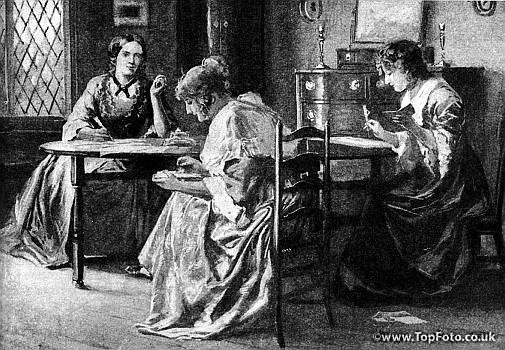
Take Your Place at the Table

Charlotte, Emily and Anne as they might have looked while writing.

The Brontë sisters fascinate me. How did one family in the early 19th century produce not one but three influential female writers? There are several carefully researched theories of course, but I’m going to go with the furniture. While Jane Austen was off at the side of the parlor writing secretly on a teeny tiny table and hiding her pages under a blotter when anyone came in, the Brontë sisters worked side by side at their dining room table with their drafts spread out around them.  Yes they were encouraged to be prolific from very young and produced astounding quality work before their early deaths, but the crucial factor for me is the table and how they wrote.  Some of the greatest novels of the 19th century took their initial shape there—Jane Eyre and Wuthering Heights,for instance.

What’s the significance of a shared table for writers and creators of any kind?

Huge.

Emily’s sketch of herself and Anne working at the table. From her journal, dated 1837.

I have a fabulous writing group, and once a month we gather at a table much like the Brontë’s.  Like the Brontës, we sit close and spread out our rough drafts. (Unlike the Brontës, we drink wine.)  We stay on topic, we read aloud. We get off topic, and we meander back. We squirm. We talk, we listen. Sometimes we yawn. We laugh all night. We debate. Those hours radically change our perspectives.  Our drafts take on weight, and our confidence in what we are saying grows.  This is the real work, and we are in it.  What matters most, to paraphrase Maurice Sendak, is our table “becomes the world all around.”

The Brontës were said to get up at times and walk around the table while working out their thoughts. Around and around the table they went, thinking, talking, and spinning words.  Without each other and the table, what are the chances their books would have been published and still read today?

Even now, early in the 21st century, gathering at a table to create is still a radical act for many of us. Facebook CEO Sheryl Sandberg in an oft shared TED talk “Why Are There So Few Women Leaders?” tells women the first key to success is to, “Sit at the table.” Boardroom table or dining room table?  Same difference.  Don’t get stuck thinking your job is to serve others. Don’t take a chair against the wall.  See that chair there in the inner circle? That one is yours.  The table is the great equalizer.

When it came time to publish their books, shocking for their time, the Brontës went with male pseudonyms first.  Back then no respectable woman wrote about passion outside marriage, rage that could destroy but was not judged, or cheeky governesses who wouldn’t be pushed around.  Governesses were usually not permitted to eat at the table with their employers, after all. In their books Emily, Charlotte and Anne protested that status, one they each would have to deal with. They were educated, unmarried women from a family without money, after all.  Where did they likely get their uppity ideas? At their own table.